'Kemana menghilang,dah tak mau main radio dah ka " hehe itu adalah pertanyaan biasa apabila berjumpa dengan rakan -rakan radio. Untuk info rakan-rakan, bukan sudah merajuk ataupun sudah hilang minat dalam dunia radio amatur ini, cuma masa yang tak mengizinkan untuk turut serta dalam aktiviti yang dirancang rakan-rakan.
Kebanyakan masa banyak dihabiskan di saltmine dan masa yang ada untuk dunia ham hanyalah boleh untuk sekadar monitor di frekuensi sahaja. Insyaallah mungkin sedikit masa lagi aku akan kembali aktif di 10m bersama dengan ND LALA kesayangan aku, sudah lama tak memancar di 10m rindu pula dengan bunyi qrm .
Nampak gayanya di 10m sekarang ni sudah menunjukkan ramai peminat yang ingin mencuba dunia tanpa sempadan, Syabas..nanti saya akan join anda semua selepas urusan kerja saya kembali berjalan seperti sedia kala..
Jadi sempena Bulan yang penuh keberkatan ini ,ingin saya memohon maaf andaikata ada tersalah atau terkasar bahasa semasa qso atau didalam penulisan blog ini.
Sekian 9w2icq 73.
CQ.CQ
 |
Monday, August 6, 2012


Wednesday, September 21, 2011
Lama tak update kat sini.
Nampak gayanya macam 10m akan membuka semula dalam minggu ini. sebab dalam minggu ini banyak stesyen yang pile up . Harap-harap dalam minggu ini ,propagasi akan membuka lagi sebab dah lama tak cq..cq kat 10m.
aku masih sama dengan set qrp ku ini. dan mungkin hujung tahun ini aku akan qsy ke tempat kerja yang baru di 9m6 land , insyaallah jika ada rezeki.
jadi untuk semua peminat 10m, tak kisah lah qro atau qrp jom pakat -pakat cq dx.
73
aku masih sama dengan set qrp ku ini. dan mungkin hujung tahun ini aku akan qsy ke tempat kerja yang baru di 9m6 land , insyaallah jika ada rezeki.
jadi untuk semua peminat 10m, tak kisah lah qro atau qrp jom pakat -pakat cq dx.
73
Monday, April 11, 2011
10m membuka semula...
salam satu malaysia semua,..agak lama tak posting didalam ni. bukan sebab tak mau main radio dah, cuma agak sibuk dengan urusan kerja yang mana memerlukan sepenuh perhatian bagi menjayakan projek yang akan datang tidak lama lagi.
walaupun dalam kesibukan harian namun 10m tetap tak dilupakan, yang menambahkan keseronokan di 10m sekarang ni adalah di mana -mana frekuensi semuanya berpenghuni..itu yang seronok tu..
jadi kepada mana - mana rakan yang ada mempunyai keupayaan untuk memancar di 10m cuba-cubalah..pasti seronok. hehe selamat memancar semua..9w2icq 73.
walaupun dalam kesibukan harian namun 10m tetap tak dilupakan, yang menambahkan keseronokan di 10m sekarang ni adalah di mana -mana frekuensi semuanya berpenghuni..itu yang seronok tu..
jadi kepada mana - mana rakan yang ada mempunyai keupayaan untuk memancar di 10m cuba-cubalah..pasti seronok. hehe selamat memancar semua..9w2icq 73.
Monday, August 2, 2010
10m telescopic antenna
Ermm, bertambah lagi accessory untuk qrp set aku ni. Terima kasih kepada 9w2di memperkenalkan antenna ni kepada aku dan terima kasih juga kepada rakan ku 9w2bzi yang sudi menolong aku memesan antenna ini.
!~~_12.JPG)
Sebenarnya ada juga terdetik di dalam kotak fikiran ku sebelum ini tentang telescopic antenna ini cuma tak yakin samada wujud atau tidak di pasaran.
Dan akhirnya 9w2di memperkenalkan antenna yang memang aku dok cari selama ini. Jadi ini adalah pelengkap kepada qrp set FT817nd ku dan dxing yang pertama menggunakan antenna telescopic ini akan ku jalankan di langkawi iaitu hari yang sama berlangsungnya JOTA. Ku harap antenna ini tak akan menghampakan tuannya dan jika berjaya maka sejarah akan tercipta dalam dunia qrp khasnya sebagai pembakar semangat untuk rakan-rakan ham yang baru nak kenal dengan dunia qrp ini
bukti, qrp memang boleh....
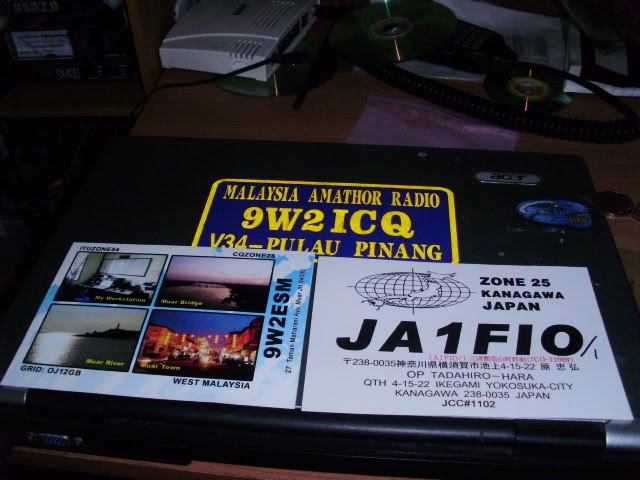
Hari ini aku telah terima 2 keping qsl card , satu daripada 9W2ESM bang sham di Johor dan satu lagi dari Mr Tada JA1FIO dari Jepun..
 Sepenuh kepercayaan ku berikan kepada FT817nd aku ini dan akhirnya terbalas jua dan kepuasan sudah mula dirasai di 10m ini walaupun agak mencabar dengan qrp set aku ini. Berbekal kan antenna homebrew delta loop dan juga ketinggian lebih kurang 50 kaki akan ku teruskan lagi penjelajahan ku di dalam dunia qrp ini. So kepada kawan-kawan yang masih tercari-cari atau masih dok pening nak beli yang mana satu, saya syorkan kepada anda bahawa set qrp ini memang berbaloi.
Jangan sesekali anda menyesal dengan apa yang anda miliki dan mengutuk apa yang anda tak dapat miliki, sebaliknya cuba menghargai apa yang dah dimiliki nescaya hidup anda akan tenang dan selamat menyambut Ramadhan al-mubarak.
QRT 73.
Monday, July 26, 2010
RAE DATANG LAGI.
Salam satu malaysia semua warga ham radio, nampak gayanya RAE kali ketiga kembali lagi walaupun keputusan RAE yang lepas belum di keluarkan namun di atas sebab sambutan baik yang ditunjukkan oleh peminat hamradio di kawasan utara dan malaysia amnya maka peperiksaan akan diadakan sebanyak 4 kali setahun.
Ini adalah satu perkembangan yang positif jika di bandingkan dengan rakan -rakan yang lebih lama bercallsign di mana mereka lebih mengalamai jerih dan pedihnya ketika hendak mengambil RAE, mana tidaknya ...peperiksaan di adakan cuma dua kali setahun dan jika gagal terpaksa menunggu lagi enam bulan untuk mengambil semula RAE semula..Uhhh perih rasanya
Namun dihati saya terdetik satu soalan, " sudah bersediakah mereka ini untuk mengambil RAE,..adakah mereka akan menjadi seorang ham yang berkualiti daripada menjadi ham yang berkuantiti.." apapun semua ini di atas diri masing -masing ibarat tepuk poket tanya selera....
kepada rakan swl yang akan mengambil RAE,...cuba anda pikirkan kembali, siapakah anda sebelum ini, siapakah yang telah bersusah payah untuk anda supaya anda sampai disini...siapakah guru anda ,...supaya selepas ini anda tidak akan lupa dimana anda bermula....
Apapun selamat menjawab soalan dan jangan lupa tarikh tutup adalah pada 13 ogos 2010 dan tarikh peperiksaan adalah pada 06 okt 2010.
cherrio...73
Ini adalah satu perkembangan yang positif jika di bandingkan dengan rakan -rakan yang lebih lama bercallsign di mana mereka lebih mengalamai jerih dan pedihnya ketika hendak mengambil RAE, mana tidaknya ...peperiksaan di adakan cuma dua kali setahun dan jika gagal terpaksa menunggu lagi enam bulan untuk mengambil semula RAE semula..Uhhh perih rasanya
Namun dihati saya terdetik satu soalan, " sudah bersediakah mereka ini untuk mengambil RAE,..adakah mereka akan menjadi seorang ham yang berkualiti daripada menjadi ham yang berkuantiti.." apapun semua ini di atas diri masing -masing ibarat tepuk poket tanya selera....
kepada rakan swl yang akan mengambil RAE,...cuba anda pikirkan kembali, siapakah anda sebelum ini, siapakah yang telah bersusah payah untuk anda supaya anda sampai disini...siapakah guru anda ,...supaya selepas ini anda tidak akan lupa dimana anda bermula....
Apapun selamat menjawab soalan dan jangan lupa tarikh tutup adalah pada 13 ogos 2010 dan tarikh peperiksaan adalah pada 06 okt 2010.
cherrio...73
Wednesday, July 14, 2010
HAMFEST MALAYSIA 2010
Hamfest Malaysia 2010 Perkenal Radio Amatur Dua-Hala
HAMFEST Malaysia 2010, pameran Radio Amatur akan dianjurkan di Tapak Menara Kuala Lumpur pada 30, 31 Julai dan 1 Ogos ini.
Hamfest Malaysia yang pertama kali diadakan itu untuk memberikan pendedahan kepada orang ramai berkenaan konsep penggunaan Radio Dua-Hala semasa aman dan bencana di Malaysia.
Festival itu akan disertai oleh Kelab-kelab Radio Amatur dari seluruh negara dan juga agensi-agensi kerajaan yang menggunakan kemudahan radio komunikasi dua-hala UHF, VHF dan HF.
Sesi penerangan oleh syarikat pengeluar sistem Radio Dua-Hala seperti Yaesu, Kenwood dan Icom serta agensi-agensi kerajaan akan diberikan kepada pengunjung mengenai penggunaan Radio Amatur di Malaysia.
Pameran penggunaan Radio Komunikasi oleh Agensi Kerajaan seperti Polis Di Raja Malaysia, Bomba dan Angkatan Tentera Malaysia turut diadakan di tapak festival itu.
Aktiviti lain yang turut diadakan termasuklah Skill-Stations, Fox Hunting dan Distance Contact Contest (DX Contest).
Saturday, July 3, 2010
DIAGRAM FOR YAGI UDA
Salam satu malaysia untuk semua pembaca, agak qrl kebelakangan ini disamping keringnya idea dan tak tahu nak tulis apa lalu aku terpandang satu diagram yang agak simple dan murah.


lalu aku bersama seorang rakan dan seorang guru telah sepakat untuk mencuba diagram ini...lalu terhasil jua apa yang dikatakan yagi ini...kerana sebelum ini aku belum pernah berpeluang menggunakan sebarang antenna yagi untuk pemancaran.
kepada cikgu ruzi...terima kasih yang tak terhingga kerana sudi berkongsi pengetahuan dan juga peralatan serta tenaga bagi membantu rakan-rakan yang dahagakan ilmu seperti kami ini.

inilah hasilnya setelah siap dan cuma tunggu untuk ujian pemancaran sahaja...untuk info rakan-rakan bacaan pada swr adalah 1.1... dan amat berbaloi untuk dicuba bersama kawan-kawan seperti kata pepatah" bukan ham jika tanpa homebrewnya"..sekian zam9w2icq..happy homebrew and happy dxing...73
Tuesday, June 22, 2010
10m telescopic antenna

Thursday, June 17, 2010
from malaysia to japan
salam satu malaysia semua para pembaca, akhirnya pada 17.06.2010 iaitu pada jam 19.15pm aku telah berjaya bekerja dengan satu stesyen dari jepun (JA1FIO) . Walaupun hanya berbekalkan yaesu ft817nd dengan kuasa 5watt sahaja aku berjaya juga walau percubaan demi percubaan di lakukan dan akhirnya panggilan aku di jawab. Ini adalah satu kepuasan yang amat sangat walaupun signal report yang diberi kurang memuaskan disebabkan banyak qrm, tapi aku berpuas hati bekerja dengan rig kesayangan ku ini.
terima kasih pada rakan-rakan yang banyak memberi semangat pada ku...dan insyaallah petang ni kita cuba lagi...
zam9w2icq.73
terima kasih pada rakan-rakan yang banyak memberi semangat pada ku...dan insyaallah petang ni kita cuba lagi...
zam9w2icq.73
Thursday, June 3, 2010

9M4RBB
untuk info kepada rakan-rakan yang melalui kawasan utara ini atau yang sedang merancang melalui kawasan utara bolehlah mengakses ke repeater 9M4RBB dengan frekuensi yang baru iaitu 145.7375 tone 103.5 dan minus 0.600. semoga perjalanan anda akan bertambah lancar dan selamat hendaknya.
wassalam -zam9w2icq.

wassalam -zam9w2icq.

Wednesday, May 5, 2010
QRP SET.

Saja kebetulan aku teringin nak bertukar angin daripada 2m kepada 10m, dalam kotak fikiran aku ini tertanya-tanya seronok ka main radio ini....pasti seronok la...kalau tak takkan aku nak ambil lesen kot dan berhabis beribu ringit beli itu ini semua pasai radio saja...
namun setelah aku bertemu dengan seorang rakan dari kedah , soalan aku terus terjawab apabila rakan tersebut berkesudian melapangkan masa menunjuk ajar aku berapa seronoknya main hf ni terutama kat 10m.
yer la..dalam AA ada memberi kepada kita untuk mempergunakan 10m band tapi sekiranya tidak digunakan adalah amat ruginya kita.....so dalam pada aku tertanya -tanya set apakah yang sesuai untuk aku sebagai permulaan dalam mencari pengalaman baru ini , jadi aku diberi cadangan supaya mengambil qrp rig jenis yaesu ft817 kerana menurut beliau itu adalah set yang terbaik buat masa kini dan senang dibawa kemana saja.
dengan kuasa pancaran 5w sahaja rasanya sudah cukup untuk aku sekiranya aku dapat set up satu antenna yang bagus untuk aku gunakan.
jadi aku masih menunggu rig idaman aku tu sampai semoga rakan-rakan aku tu nanti jangan meleleh air liur bila nampak set baru ku ini masa eyeball nanti, jom pakat -pakat monitor 10m hehehe...
Tuesday, February 9, 2010
RAE RESULTS
Tu dia dah keluar rupanya results hari ini, emm..mesti ada yang ceria , geram, kecewa rasa tak mau main radio dah dan juga macam- macam rasa lagi yang tak di nyatakan disini.
Tapi ini semua adalah lumrah bagi setiap kali result rae keluar , perasaan yang macam2 ada ini memang tak boleh control punya namun sekiranya anda sudah lulus dan bakal mempunyai 9w2 maka janganlah anda lupa dari mana anda bermula.
Maka lepas ni makin bertambah lah jumlah rakan -rakan ham di malaysia ini. Untuk rakan -rakan yang gagal dalam percubaan kali ini, janganlah anda tertekan kerana peluang masih tersedia buat anda sebab gagal sekali bukan bermaksud gagal selamanya kerana anda masih boleh bangun untuk cuba dan cuba lagi.
Apa pun tahniah sekali lagi buat rakan - rakan yang lulus dan yang kurang bernasib baik boleh hantar lagi borang permohonan dan sekiranya ada kelas yang di anjurkan seboleh- bolehnya lapangkan lah masa anda untuk menghadirinya sebab banyak ilmu yang dapat kita pelajari disana sebab malu bertanya sesat jalan..wassalam...zam9w2icq-73
Monday, January 25, 2010
RAE DATANG LAGI
21JAN01 – Notification: First Series of the Radio Amateur Examination and Morse Code Test for 2010
21 January 2010
The Malaysian Communications and Multimedia Commission (SKMM) will be holding the first series of Radio Amateur Examination (RAE) and the Morse Code Test (CW) for the year 2010.
The Morse Code Test (CW) will be held at 10.00 a.m. on 17 March 2010 at the SKMM HQ in Cyberjaya. Applications close at 5.00 p.m. on 5 February 2010.
The Radio Amateur Examination (RAE) will be held at 2.00 p.m. on 14 April 2010 at locations in the Northern and Central Regions of Peninsular Malaysia. Applications close at 5.00 p.m. on 12 February 2010.
Thursday, November 5, 2009
antenna astra @kaki biawak
lama juga tak menjenguk kedalam blog aku ni, maklum lah sibuk dengan tugasan saltmine.


namun dalam sibuk -sibuk aku ni sempat jugalah aku mencuba satu jenis antenna yang suatu masa dulu amat popular di kalangan rakan-rakan radio iaitu antenna astra ataupun kaki biawak.
setakat mana popularnya tu tak tau pulak sebab tak ditulis ratingnya berapa tapi memang berbaloi dan senang untuk di buat.
gambar dan diagram ini saya dapat daripada salah seorang rakan ham kita iaitu 9w2wtf dan banyak info yang saya dapat dari dalam blog beliau.
untuk anda yang tercari-cari antenna apa yang ingin cuba di brew kan, cuba lah yang ini dulu sebab murah dan mudah ,. 73
Wednesday, January 28, 2009
power suply.
Here is a guide to modify your PC power supply unit to power up your mobile rig. If its done correctly you can have a cheap (regulated) VDC power supply solution for your mobile rig to operate at home.
Step I
First get a ATX PC power supply from the nearest computer store. Price is around RM30-70.

Make sure it could supply sufficient current. Look at the label. We need at least 10-17amp at 12V for a sufficient operation of mobile rig. Lower Ampere rating means that your mobile rig cant transmit with a typical HiGH setting (50w).
Step 2
Look for ATX power connector. It should look like this.

Look for black and green wire at the ATX connector. The wire position is 4th from the top left side of the connector and 4th from the bottom right side from the connector as pictured above.

Cut the black and green wire. Trim all the other wires as we wont need them.

Tie both Black and Green wire together.

Connect both Green and Black wire to bypass the PC Power Supply unit. Insulate it with some tape. and switch on the power supply. If the fan is running, that means you’ve successfully completed this step!
Step 3.

Turn off the power supply. Look for HDD, CDROM power connector, as pictured above.

Cut all wire from the connector.

Separate 2 black wires and one yellow wire. Combine both black wires together.


Look for an extra mobile rig power connector, this can be obtained from electronic shops car accessories, or car battery shop.
Connect the yellow wire (+12 volt DC) to the positive terminal at the power connector as pictured above. Connect both black wires together and put it to the negative terminal as picture above too.
Step 4
Cut all unnecessary wires, connector, and leave the power supply with just the rig power connector like this. It will look much more presentable and neatly prepared.


You can test the output voltage of this power supply by testing it with Voltmeter/Multimeter. Here you can see that the power supply output voltage is about 12V, which is suffiecient to power a mobile rig (13.8V +/- 15%).
Step 5

Finally, connect the power supply to your mobile rig to power it up. Enjoy your QSO!
FAQ: Nice, but my mobile rig require 13.8VDC to operate, this PSU only supplies 12V, it won’t work
Actually it can work. Mobile rigs requires 13.8 +/- 15% VDC to work (check your rig manual). and that gives a range about 11.7V - 15.8V of stable voltage potential. So a 12V power supply with sufficient current (15A and above) is definitely sufficient to power the mobile rigs.
Friday, December 5, 2008
gps system
What is GPS? |  | |
 | ||

How it works
GPS satellites circle the earth twice a day in a very precise orbit and transmit signal information to earth. GPS receivers take this information and use triangulation to calculate the user's exact location. Essentially, the GPS receiver compares the time a signal was transmitted by a satellite with the time it was received. The time difference tells the GPS receiver how far away the satellite is. Now, with distance measurements from a few more satellites, the receiver can determine the user's position and display it on the unit's electronic map.

A GPS receiver must be locked on to the signal of at least three satellites to calculate a 2D position (latitude and longitude) and track movement. With four or more satellites in view, the receiver can determine the user's 3D position (latitude, longitude and altitude). Once the user's position has been determined, the GPS unit can calculate other information, such as speed, bearing, track, trip distance, distance to destination, sunrise and sunset time and more.
How accurate is GPS?
Today's GPS receivers are extremely accurate, thanks to their parallel multi-channel design. Garmin's 12 parallel channel receivers are quick to lock onto satellites when first turned on and they maintain strong locks, even in dense foliage or urban settings with tall buildings. Certain atmospheric factors and other sources of error can affect the accuracy of GPS receivers. Garmin® GPS receivers are accurate to within 15 meters on average.


The GPS satellite system
The 24 satellites that make up the GPS space segment are orbiting the earth about 12,000 miles above us. They are constantly moving, making two complete orbits in less than 24 hours. These satellites are travelling at speeds of roughly 7,000 miles an hour.
GPS satellites are powered by solar energy. They have backup batteries onboard to keep them running in the event of a solar eclipse, when there's no solar power. Small rocket boosters on each satellite keep them flying in the correct path.
Here are some other interesting facts about the GPS satellites (also called NAVSTAR, the official U.S. Department of Defense name for GPS):
- The first GPS satellite was launched in 1978.
- A full constellation of 24 satellites was achieved in 1994.
- Each satellite is built to last about 10 years. Replacements are constantly being built and launched into orbit.
- A GPS satellite weighs approximately 2,000 pounds and is about 17 feet across with the solar panels extended.
- Transmitter power is only 50 watts or less.
What's the signal?
GPS satellites transmit two low power radio signals, designated L1 and L2. Civilian GPS uses the L1 frequency of 1575.42 MHz in the UHF band. The signals travel by line of sight, meaning they will pass through clouds, glass and plastic but will not go through most solid objects such as buildings and mountains.
A GPS signal contains three different bits of information — a pseudorandom code, ephemeris data and almanac data. The pseudorandom code is simply an I.D. code that identifies which satellite is transmitting information. You can view this number on your Garmin GPS unit's satellite page, as it identifies which satellites it's receiving.
Ephemeris data tells the GPS receiver where each GPS satellite should be at any time throughout the day. Each satellite transmits ephemeris data showing the orbital information for that satellite and for every other satellite in the system.
Almanac data, which is constantly transmitted by each satellite, contains important information about the status of the satellite (healthy or unhealthy), current date and time. This part of the signal is essential for determining a position.

Sources of GPS signal errors
Factors that can degrade the GPS signal and thus affect accuracy include the following:
- Ionosphere and troposphere delays — The satellite signal slows as it passes through the atmosphere. The GPS system uses a built-in model that calculates an average amount of delay to partially correct for this type of error.
- Signal multipath — This occurs when the GPS signal is reflected off objects such as tall buildings or large rock surfaces before it reaches the receiver. This increases the travel time of the signal, thereby causing errors.
- Receiver clock errors — A receiver's built-in clock is not as accurate as the atomic clocks onboard the GPS satellites. Therefore, it may have very slight timing errors.
- Orbital errors — Also known as ephemeris errors, these are inaccuracies of the satellite's reported location.
- Number of satellites visible — The more satellites a GPS receiver can "see," the better the accuracy. Buildings, terrain, electronic interference, or sometimes even dense foliage can block signal reception, causing position errors or possibly no position reading at all. GPS units typically will not work indoors, underwater or underground.
- Satellite geometry/shading — This refers to the relative position of the satellites at any given time. Ideal satellite geometry exists when the satellites are located at wide angles relative to each other. Poor geometry results when the satellites are located in a line or in a tight grouping.
- Intentional degradation of the satellite signal — Selective Availability (SA) is an intentional degradation of the signal once imposed by the U.S. Department of Defense. SA was intended to prevent military adversaries from using the highly accurate GPS signals. The government turned off SA in May 2000, which significantly improved the accuracy of civilian GPS receivers.
Thursday, November 27, 2008
HF BAND CHARACTERISTICS
160 meters (night) 1.8 - 2.0 MHz
A neighbor to the AM Broadcast band, Very similar conditions to what you hear on AM Broadcast, quite localized during the day, with long distance capability at night. During the summer months the long distances at night can be several hundreds of miles and during the winter it can be several thousand miles. Sometimes noise created by static crashes hinder communications in the summer months but very nice in the winter! 80 meters (night and local during the day)3.5 - 4.0 MHz80 Meters is very similar to 160 meters but with greater distances especially at night. 80 tends to be a very reliable band less subject to variations of the sunspot cycle and is used a lot for regular net operations and message handling and "local rag chewing". Again can be very noise prone in the summer static.
60 meters (night and local during the day)5.330.5 - 5.403.5 MHz
40 meters (night and local during the day)7.0 - 7.3 MHz
This is many ham's favorite band. It is always open somewhere. During the summer daytime distances of 300-400 miles and night time distances of 1000 miles are very common. Winter days with 500 miles or more are usual and night time conditions bring DX intercontinental communications. This band is shared with short-wave broadcast from countries outside of North America. Between these interfering signals a ham with a reasonable station can work stations worldwide if you can find a clear spot!. Not as affected by the sunspot cycle as 20-10 meters.30 meters (CW and digital only)10.100 - 10.150 MHzA lot like 40 meters but can only be used on CW and RTTY. No broadcast interference and has slightly longer range than 40 meters. Daytime ranges of 1000 miles are quite common.
20 meters (world-wide day and night)14.000 - 14.350 MHz
Just about all of the serious DXers hang out on 20 meters!This can be a VERY exciting band with some of the best DX found on any band. Around the world daytime communications are generally possible and when the sunspot cycle is peaking 20 can be used around the clock! Not likely to be used for short-range communications. The only way to work someone a few hundred miles away would be scatter or possibly "long path". Ground wave signals of about 50-75 miles might be all you would expect. At the bottom of the sunspot cycle, openings to other continents are short, rare and few and far between.
17 meters (world-wide day and night)18.068 - 18.168 MHz
Band conditions are very similar to 20 meters. This seems to be a very popular band when hams go mobile and lots of fun can be expected.
15 meters (primarily daytime)21.000 - 21.450 MHz
A lot like 20 meters but a bit more flakey.. More influenced by the sunspot cycle. Much less night time activity than 20 meters but at the peak of the sunspot cycle, 15 can provide much greater distances! On the down side, at the bottom of the cycle, 15 may not open for days.
12 meters (primarily daytime)24.890 - 24.990 MHz
Very heavily influenced by the sunspot cycle. At the bottom of the cycle it is suitable only for very short distance ground wave communications only for long periods of time. At the peak of the cycle it is capable of communications over thousands of miles with a minimum of equipment. Another nice mobile band when conditions are right.
10 meters (daytime during sunspot highs)28.000 - 29.7000 MHz
This is the HF band most heavily affected by sunspots and the sunspot cycle and it can be erratic and exciting at the same time with lots of Dx for the qsl hunter or just as a fun band. Minimum power and simple antennas can bring you a hundred countries in a short period of time when the sunspot cycle is rising towards the peak. Five watts or even less can work half way around the earth!. Ground wave coverage is 25 miles or so. Lots of beacon stations worldwide for DX hunters.
Tuesday, November 25, 2008
radio amatur
BAGAIMANA HENDAK MENJADI OPERATOR RADIO AMATUR DI MALAYSIA
Apakah itu Radio Amatur?
Sepuluh Perkara yang anda perlu tahu berkenaan Radio Amatur
(dipetik dari risalah MCMC)
Radio Amatur atapun juga dikenali sebagai “Ham Radio” ialah hobi berkenaan membina, menguji-kaji dan berkomunikasi melalui radio.
Pengguna-pengguna Radio Amatur ini saling berhubung dengan rakan-rakan mereka seluruh dunia melalui beberapa set-set frekuensi radio yang telah ditetapkan.
Bilakah Radio Amatur bermula?
Sejarah Radio Amatur ini telah bermula semenjak perhubungan radio digunakan. Pada tahun 1912, Kongress Amerika Syarikat telah meluluskan undang-undang pertama bagi mengawal selia pemancaran radio di Amerika Syarikat. Bermula 1914, pengguna Radio Amatur telah mula berkomunikasi dan mengadakan satu system penghantaran mesej di antara mereka. Di Malaysia, radio amatur merupakan titik bermulanya perkhidmatan radio komersil.
Apakah yang boleh saya lakukan dengan Radio Amatur?
Tidak seperti teknologi perhubungan lain, Radio Amatur membolehkan anda berhubung dari mana-mana tempat, pada setiap masa! Pada waktu-waktu bencana, Radio Amatur amat berguna, terutamanya kepada agensi-agensi penyelamat. Pada ketika lain, anda juga kadang kala boleh bercakap dengan para angkasawan atau membalikkan isyarat dari bulan! Anda juga boleh menghantar fail ataupun gambar secara digital. Adakah hobi lain yang menyediakan sebegitu ciri sepertinya?
Saya sentiasa sibuk. Adakah saya masih boleh menikmati hobi ini?
Sudah tentu! Hobi ini tidak terikat kepada sesuatu masa, tempat dan pendapatan seseorang. Memandangkan ianya mudah dikendalikan, ramai yang sentiasa sibuk mendapati ianya seronok digunakan dan mengurangkan tekanan selepas seharian bekerja. Anda dan juga keluarga anda juga boleh menikmati dan mempelajari hobi ini.
Apakah perbelanjaan yang diperlukan bagi hobi ini?
Sebuah radio bersaiz telapak tangan yang baru mungkin sama harganya dengan satu TV 19 inci yang berkos rendah. Radio yang lebih besar adalah sama kosnya dengan satu komputer.
Selain dari itu, bahan-bahan pembelajaran berkenaan Radio Amatur adalah berpatutan dan yuran peperiksaan bagi mendapatkan Sijil Perakuan juga adalah rendah.
Secara alternatif, sekiranya anda cenderung untuk menguji-kaji, seperti kebanyakaan pengguna Radio Amatur atau “Ham Radio”, anda boleh membuat unit “Ham Radio” anda sendiri.
Siapa yang boleh membantu saya?
Kelab-kelab Radio Amatur terdapat di seluruh Malaysia dan bersedia untuk membantu anda. Ada di antara kelab-kelab tersebut mempunyai halaman web yang mengandungi maklumat mengenai hobi tersebut.
Bagaimana saya boleh menjadi seorang operator Radio Amatur?
Hanya mereka yang telah diperakukan boleh mengendalikan sesuatu alat Radio Amatur. Bagi mendapatkan Sijil Perakuan, anda haruslah warganegara Malaysia berusia 14 tahun ke atas dan lulus ujian-ujian berikut:
* Ujian Teori Radio dan Kefahaman Peraturan Radio bagi Sijil Perakuan Kelas B; atau
* Ujian Kod Morse dan ujian-ujian teori dan radio di atas bagi Sijil Perakuan Kelas A.
Siapakah yang mengeluarkan Sijil Perakuan itu?
Sijil Perakuan tersebut dikeluarkan oleh Suruhanjaya Komunikasi dan Multimedia Malaysia kepada mereka-mereka yang telah lulus ujian yang diadakan.
Adakah saya perlu membayar yuran?
Ya, Sijil Perakuan tersebut haruslah diperbaharui setiap tahun. Yuran tahunan bagi Sijil Perakuan Kelas A adalah sebanyak RM36 dan bagi Sijil Perakuan Kelas B, yurannya adalah RM24 setahun.
Apakah yang boleh saya pelajari sebagai permulaan?
Anda boleh memulakan pelajaran anda dengan mempelajari fonetiks abjad yang digunakan oleh pengguna-pengguna Radio Amatur di seluruh dunia!
Radio Amatur atapun juga dikenali sebagai “Ham Radio” ialah hobi berkenaan membina, menguji-kaji dan berkomunikasi melalui radio.
Pengguna-pengguna Radio Amatur ini saling berhubung dengan rakan-rakan mereka seluruh dunia melalui beberapa set-set frekuensi radio yang telah ditetapkan.
Bilakah Radio Amatur bermula?
Sejarah Radio Amatur ini telah bermula semenjak perhubungan radio digunakan. Pada tahun 1912, Kongress Amerika Syarikat telah meluluskan undang-undang pertama bagi mengawal selia pemancaran radio di Amerika Syarikat. Bermula 1914, pengguna Radio Amatur telah mula berkomunikasi dan mengadakan satu system penghantaran mesej di antara mereka. Di Malaysia, radio amatur merupakan titik bermulanya perkhidmatan radio komersil.
Apakah yang boleh saya lakukan dengan Radio Amatur?
Tidak seperti teknologi perhubungan lain, Radio Amatur membolehkan anda berhubung dari mana-mana tempat, pada setiap masa! Pada waktu-waktu bencana, Radio Amatur amat berguna, terutamanya kepada agensi-agensi penyelamat. Pada ketika lain, anda juga kadang kala boleh bercakap dengan para angkasawan atau membalikkan isyarat dari bulan! Anda juga boleh menghantar fail ataupun gambar secara digital. Adakah hobi lain yang menyediakan sebegitu ciri sepertinya?
Saya sentiasa sibuk. Adakah saya masih boleh menikmati hobi ini?
Sudah tentu! Hobi ini tidak terikat kepada sesuatu masa, tempat dan pendapatan seseorang. Memandangkan ianya mudah dikendalikan, ramai yang sentiasa sibuk mendapati ianya seronok digunakan dan mengurangkan tekanan selepas seharian bekerja. Anda dan juga keluarga anda juga boleh menikmati dan mempelajari hobi ini.
Apakah perbelanjaan yang diperlukan bagi hobi ini?
Sebuah radio bersaiz telapak tangan yang baru mungkin sama harganya dengan satu TV 19 inci yang berkos rendah. Radio yang lebih besar adalah sama kosnya dengan satu komputer.
Selain dari itu, bahan-bahan pembelajaran berkenaan Radio Amatur adalah berpatutan dan yuran peperiksaan bagi mendapatkan Sijil Perakuan juga adalah rendah.
Secara alternatif, sekiranya anda cenderung untuk menguji-kaji, seperti kebanyakaan pengguna Radio Amatur atau “Ham Radio”, anda boleh membuat unit “Ham Radio” anda sendiri.
Siapa yang boleh membantu saya?
Kelab-kelab Radio Amatur terdapat di seluruh Malaysia dan bersedia untuk membantu anda. Ada di antara kelab-kelab tersebut mempunyai halaman web yang mengandungi maklumat mengenai hobi tersebut.
Bagaimana saya boleh menjadi seorang operator Radio Amatur?
Hanya mereka yang telah diperakukan boleh mengendalikan sesuatu alat Radio Amatur. Bagi mendapatkan Sijil Perakuan, anda haruslah warganegara Malaysia berusia 14 tahun ke atas dan lulus ujian-ujian berikut:
* Ujian Teori Radio dan Kefahaman Peraturan Radio bagi Sijil Perakuan Kelas B; atau
* Ujian Kod Morse dan ujian-ujian teori dan radio di atas bagi Sijil Perakuan Kelas A.
Siapakah yang mengeluarkan Sijil Perakuan itu?
Sijil Perakuan tersebut dikeluarkan oleh Suruhanjaya Komunikasi dan Multimedia Malaysia kepada mereka-mereka yang telah lulus ujian yang diadakan.
Adakah saya perlu membayar yuran?
Ya, Sijil Perakuan tersebut haruslah diperbaharui setiap tahun. Yuran tahunan bagi Sijil Perakuan Kelas A adalah sebanyak RM36 dan bagi Sijil Perakuan Kelas B, yurannya adalah RM24 setahun.
Apakah yang boleh saya pelajari sebagai permulaan?
Anda boleh memulakan pelajaran anda dengan mempelajari fonetiks abjad yang digunakan oleh pengguna-pengguna Radio Amatur di seluruh dunia!
Abjad yang----------------Kod digunakan------------------Cara sebutan
Hendak dihantar
Hendak dihantar
A-------------------------------Alfa--------------------------AL FAH
B-------------------------------Bravo------------------------BRAH VO
C------------------------------Charlie-----------CHAR LEE atau SHAR LEE
D-------------------------------Delta-------------------------DELL TA
E-------------------------------Echo-------------------------ECK OH
F-------------------------------Foxtrot----------------------FOKS TROT
G-------------------------------Golf-------------------------GOLF
H-------------------------------Hotel------------------------HOH TEL
I--------------------------------India------------------------IN DEE AH
J-------------------------------Juliet----------------------JEW LEE ETT
K------------------------------Kilo--------------------------KEY LOH
L-------------------------------Lima------------------------LEE MAH
M-------------------------------Mike------------------------MIKE
N-----------------------------November-----------------NO VEM BER
O------------------------------Oscar------------------------OSS CAH
P------------------------------Papa-------------------------PAH PAH
Q------------------------------Quebec----------------------KEH BECK
R------------------------------Romeo-----------------------ROW ME OH
S-------------------------------Sierra----------------------SEE AIR RAH
T------------------------------Tango-----------------------TANG GO
U------------------------------Uniform------------------YOU NEE FORM
V------------------------------Viktor-----------------------VIK TAH
W-----------------------------Whiskey---------------------WISS KEY
X-----------------------------X-Ray------------------------ECKS RAY
Y-----------------------------Yangkee---------------------YANG KEY
Z-------------------------------Zulu----------------------ZOO LOO
Subscribe to:
Posts (Atom)